"When the Eagle returns we will again be a great nation." - Jonas Shawandase, Grand Traverse Band tribal elder, 1930s-1950s. [From the book The Eagle Returns by Matthew L.M. Fletcher.]

Jonas Shawandase was born 7 Jul 1882, the son of Louis Shawadase and Sarah Waysayquoum. He also gave his birth as 7 Jul 1879, explaining he made himself three years older to join the military in 1900. First name was often listed as Jonah, last name spelled many different ways.
Sister Nancy was born 14 Aug 1884 in Leelanau township, Leelanau, Michigan. [She died prior to the 1894 census.]
Brother Samson was born 15 Apr 1888 in Leelanau township, Leelanau, Michigan [He was living in 1900, died prior to the 1908 Durant Roll]
Sister Jessie was born 15 Mar 1892 in Leelanau township, Leelanau, Michigan
1894 Michigan State Census - Leelanau, Leelanau, Michigan
Shawandasy, Louis, 40 husband, married
Sarah, 38, wife, married, 7 children born, 3 children living
Jonah, 13, son
Samson, 6, son
Jessie, 2, daughter

On 19 Sep 1894 Jonas (called Jonah Sonday) arrived at the Carlisle School. He was 14 years old.

Students were sent on what was called outings. They were laborer for the families listed. Jonas worked for the following.
7 May 1895 to D. Palmer, Edgewood, PA, returned to school 14 Sep 1895
27 Mar 1896 to R. Muschert, Morrisville, PA, returned to school 14 Sep 1896
12 Sep 1896 to J. White, Bristol, PA, returned to school 5 Oct 1896
30 Mar 1897 to G. Hilton, Carlisle, PA, returned to school 10 Sep 1897
26 Apr 1897 to J. Clayton, Holmeville, PA, returned to school date not given
31 Mar 1900 to A. Knight, Holmeville, PA, returned to school "ran"

Savings account ledger page for Jonas

Brother Dennis was born 15 Jul 1897 in Leelanau township, Leelanau, Michigan.
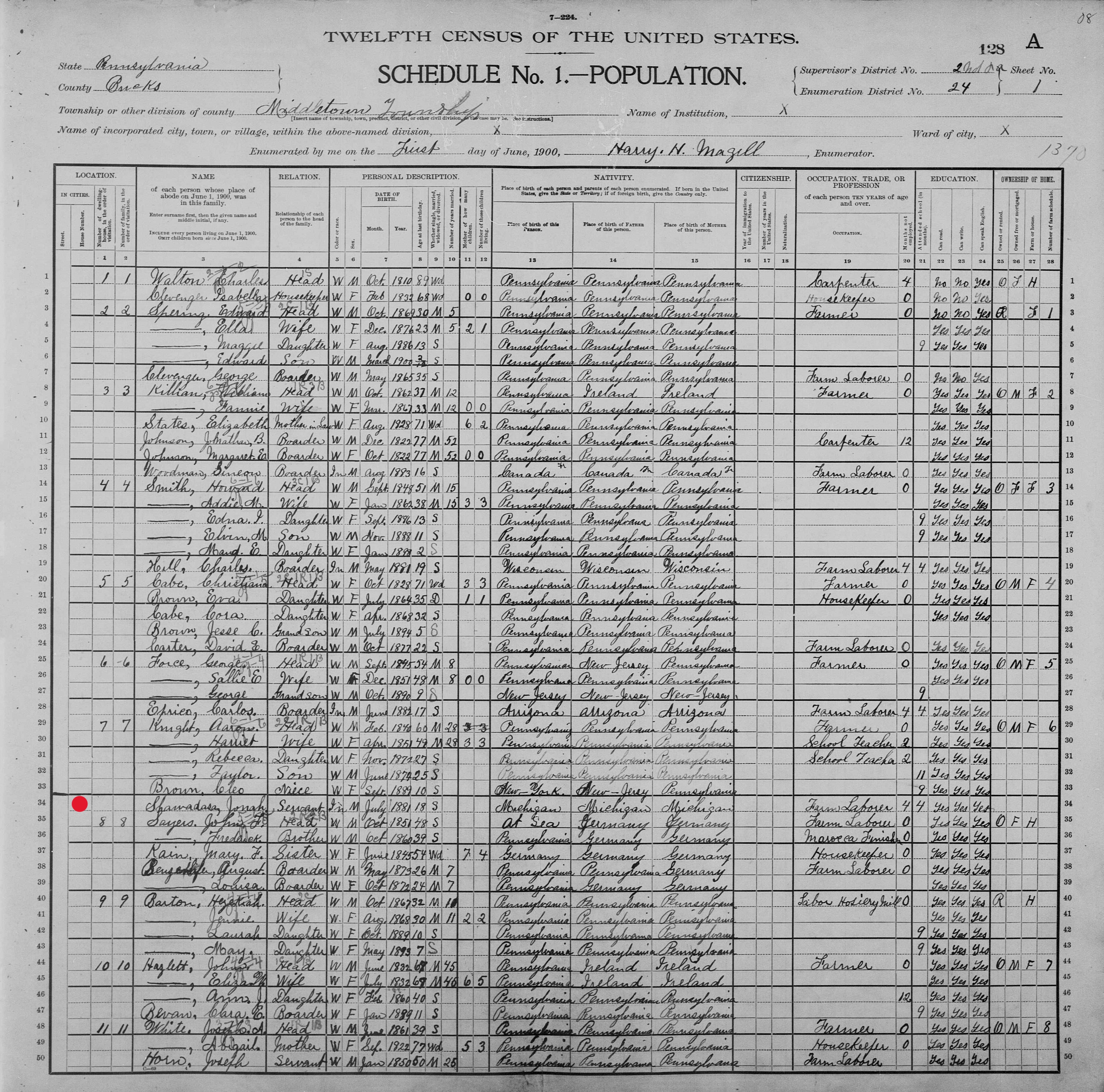
1900 Federal Census - Middleton, Bucks, Pennsylvania - taken 1 Jun 1900
In the home of Aaron Knight
Shawadasa, Jonah, servant, born July 1881, age 18, farm laborer.
1900 Federal Census - North Middleton Township, Cumberland, Pennsylvania - Indian Industrial School at Carlisle - taken 8 Jun 1900
Line 23 Shawandasa, Jonah, born 1880, age 20, born Michigian, parents born Michigan, at school, Ottawa, parents Ottawa, full.

From the student information card Jonah left school on 20 Sep 1900, called a deserter. This was 6 years after he was admitted for a 5 year perioed.
A week prior, on 13 Sep 1900, Jonah enlisted in Company E, 2nd Cavalry, US Army
Enlistment papers


Exam papers


Shawadasa, Jonah, enlisted 13 Sep at Philaelphia, born North Port, age 21, Laborer, eyes brown, hair dark, Indian, 5' 6 1/2", Cav. company E, discharged 12 Sep 1903 at Fort Myer, VA.

On 13 Mar 1903, Jonas was admitted at Fort Myer, VA, for vaccinia, a virus related to horsepox. He was discharged 17 Mar 1903.

The Washington Times - 25 Apr 1903
CRACK SOLIDERS GOING TO MILITARY CARNIVAL
Engineers From Washington Barracks and Troopers From Fort Myer to Drill in Madison Square Garden.
The composite trooms from Fort Myer and the Washington Barracks which are to take part in the bi military carnival at Madison Square Grden Monday will leave the city tomorrow morning at 8:30 by the Pennsylvania Railroad.
Capt. Lloyd M. Brett, commanding Troop F, will have charge of the men from Fort Myer, and Capts. M. L. Walker and J. F. McIndoe will command the engineers.
The bridge building squad had a final drill yesterday afternoon. Forty men, one-half from Company L and one-half from Company M, built a pontoon bridge 125 feet long, blew it up, tore it down, returned the timbers to their place, and stood to attention within seen minutes from the time when the order was given to commence.
A Fine Performance.
When it is remembered that this performance followed just five minutes after another, the fine form of the men can be realized.
Captain Brett's troop have packed up after a short final drill yesterday.
The money earned at the Madison Square Garden--admission is to be charged--will be devoted to building gymnasiums and buying baseball, football, and other athletic outfits for the men.
The men from Fort Myer are as follows:
Saddle squad, Troop F--First Sergeant McNally, Sergeants Stegman, Haloner and Thurston, Corporals Hemmett and Davis, Saddler McCampbell, Wagoner Workman, Privates Buchan, Burke, Carroll, Collior, Farrom, Holland, Hyde, Montgomery, Noise, McCabe, McCormick, McIntyre, O'Donnell, Ryan.
Troop G--Sergeant Phelps, Corporal Stevens.
Troop H--Sergeant Burkey, Privates Cox, Pegow, More.
Bareback squad. Troop F--Sergeant Katz, Corporal Davidson, Trupmpeters Laird, Man, Millen; Privates Bumworth, Croy Hawkins, Webb, Wesaman.
Troop C--Corporal Grace, Trumpeter Fox, Privates Egana, Foyk, Logan, Needham.
Troop F--Band: Private Griffith
Troop E--Corporal Haggard, Privates Jackson, Mason, Miller, Shawadasa.
These squads represent the pick of the two posts, men chosen for their intelligence and soldierly appearance.


Evening Star, Washington D.C. 27 Apr 1903
ATHLETIC TOURNEY
TROOPS LEAVE FOR NEW YORK TO PARTICIPATE
Crack Organizations to Display Skill in Military Evoluntions Exhibition Drills
The troops of cavalry and engineer corps of the army stations at Fort Myer and the Washington barracks, respectively, designated to participate in the military athletic, tournament which begins in New York today left yesterday morning at 8:30 o'clock over the Pennsylvania railraod [sic] for the city named. All day Saturday the troops busied themselves in packing up their equipment and storing it in the freight cars in which it was to be transported to New York. The men will carry everything they need for a week, except tents. They will be quartered in one of the national guard armories in New York city, and will there perform all the duties required of them at a regular military post, the exhibition drills at Madison Square Garden taking the place of the daily drill.
The officers were quartered last year at the Waldorf-Astoria Hotel, but this year they will be required to remain in the quarters assigned to the men. The expense of the trip to New York and for substinence and quarters while there, is born by the military athletc league, under the auspices of which the exhibition is being given.
The troops will all be paid for the work they do at the exhibition and this money will be used to imporve the qymnasium at the two posts. The gymnasium at Fort Myer is in the attic of the barracks used by troop F, and while the appliances are modern and are kept in good condition, the place is not all that coud be desired, and more conveniences are required. When the large post exchange building is erected, for which more than a hundred thousand dollars is to be spent, there will be ample room for a fine gymnasium and every effort will be made to fit it out completely. Some of the money appropriated for the building may be used in fitting out the gymnasium, if it is not all used in the construction and furnishing of the other portions of the building.
The Cavalry Exhibition
The cavalry detachment from Fort Myer will perform the same evolutions at Madison Square that it has performed here during the winter, with the added movements that have been practiced and shown during the later drills. The detachment is made up of details from each troop, the men from Troop F being in larger numbers than any of the other troops. The composite organization is commanded by Capt. Lloyd M. Brett of Troop F, with First Lieut. Charles G. Harvey of Troop F and Second Lieut. Joseph Taulbee of Troop H.
The following men have been drawn from the four troops stationed at Fort Myer to compose the crack riding detachment:
Saddle squad, Troop F--First Sergt. McNally, Sergts. Stegman, Haloner and Thurston, Corps. Hemmett and Davis, Saddler McCampbell, WAgoner Workman, Privates Buchan, Burke, Carroll, Collior, Farrom, Holland, Hyde, Montgomery, Nois, McCabe, McCormick, McIntyre, O'Donnell and Ryan.
Troop G--Sergt. Phelps, Corp. Stevens,
Troop H--Sergt. Burkey, Privates Cox, Pegow, More.
Bareback squad, Troop F--Sergt. Katz, Corp. Davidson, Trumpeters Laird, Man, Millen, Privates Bumworth, Croy, Hawkins, Webb and Wesaman.
Troop G--Corp, Grace, Trumpeter Fox, Privates Egana, Foyk, Logan and Needham.
Band--Private Griffith
Troop E--Corp. Haggard, Privates Jackson, Mason, Miller and Shawadasa.


Jonas was discharged from the Army on 12 Sep 1903.
Veterans Administration Master Index Card

Traverse City Record-Eagle 31 Oct 1903
BIG INDIAN AT NORTHPORT
That Town is the Home of One of the Most Famous Red Man in the United States.
Northport, besides being the home of a car ferry, can also boast of being the home of one of the most famous Indians of the country.
Jonas Shawandasa, son of Lewis Shawandasa, who lives three miles west of Northport, left his home nine years ago and spent six years at the Carlisle school in Kansas according to the Northport Leader.
The following taken from the Advance, published at Hulmeville, Pa., give an interesting bit of information about the young man of 22 years and the record he has made since leaving home:
"Jonas Shawandasa, A Chippewa Indian, employed on the farm of Jonathan Clayton in Bensalem, near this place, several years ago, and who enlisted in the Second United States cavalry, was mustered from the service at Fort Myers, Va., on Saturday last, the 12th inst. Since leaving this vicinity, three years ago, he has seen service in Cuba and at various points in this country, and has gained the reputation of being the best horseman in Troop E, of which he was a member. Newspapers all over the country have at various times shown pictures of him in the act of performing difficult feats of horsemanship, such as picking up a dollar bill from the ground while his horse was going at full gallop. He was a member of the detachment of the Second cavalry that was sent to attend a reunion of the army of Santiago, held at Detroit, Mich., last month, and added greatly to his reputation as a rough rider. We congratulate Jonas upon his excellent record in the United States army, and hope he will continue to gain laurels in his civil life. He has already received flattering offers from a number of showmen to go upon the road and give exhibitions of rough and fancy riding.


The Bucks County Gazette, Bristol, Pennsylvania 21 Apr 1904

By the end of 1905 Jonas had changed careers.
The Bucks County Gazette, Bristol, Pennsylvania 28 Dec 1905

The Indian News, Genoa Nebraska - 1 Nov 1908

1908 Durant Roll Field notes Line 1 page 38
Waw-say-quo-um, George, age 92, P.O. Northport, wife dead, name not given.
Child #4 Sarah (Waw-say-quo-um) Shondayse Shaw-wan-day-se, age 55, P.O. Northport, see 20-38
Husband Louis Shaw-wan-day-se, age 51, P.O. Northport, see 8-23
Their children:
1) Jonah, age 28, P.O. Genoa Nebr.
2) Jessie, age 16, P.O. Northport
3) Dennis, age 8, P.O. Northport

Durant Roll Field notes Line 8 page 23
Mway-ke-we-naw or Peter Shaw-waw-day-se, 78, P.O. Northport, wife dead
Child #1 Louis Shaw-waw-day-se, age 51, wife Sarah Was-say-quom, age 55, see children #1 p 38.

1910 Federal Census - Genoa, Nance, Nebraska
Shawndosa, Jonas L., head, male, Indian, age 28, single, born Michigan, speaks English, Engineer at U. S. Indian School

Clipping from Jonas' Carlisle student file.

Sha-sko-ke-zhik Camp Meeting - 1910 Northport

Jonas Show-an-da-sa, son of Christianized father,
(choir leader) Louis Show-an-da-sa, at Sha-sko-ke-zhik.
Jonas prefers warpaint and eagle feathers and life
in the movies to the civilizing influen(c)es of his
ancesters. H(e) is visiting relatives at Sha-sko-ke-zik
The Indian News, Genoa, Nebraska - 1 Nov 1910

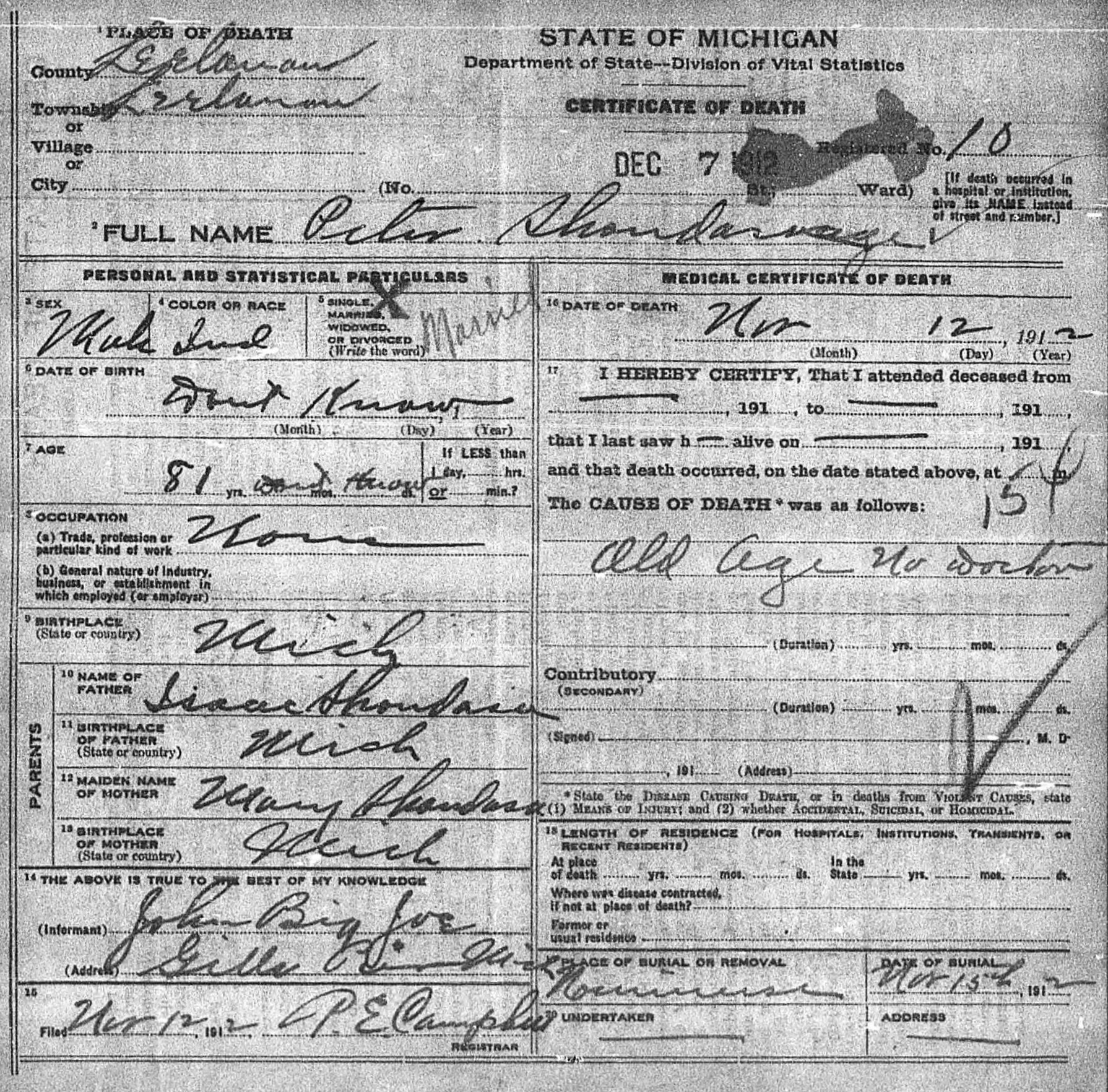
Jonas' grandfather, Peter Shawandase, died 12 Nov 1912 in Leelanau, Leelanau, Michigan. Age was given as 81, parents as Isaac and Mary.
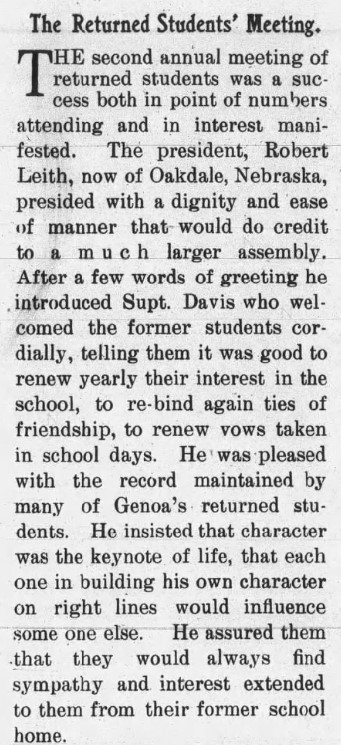
The Indian News, Genoa Nebraska - 1 Dec 1913


The Indian News, Genoa Nebraska - 1 May 1914


Adaleen Greenbrier was born 22 Apr 1892 in Cleveland, the daughter of George Greenbrier and Jemima Adaleen Mousseau.
Mention of the marriage was found in Adaleen's student file at Carlisle. Clipping from The Indian News at Genoa, Nebraska.

The Indian News, Genoa Nebraska - 1 Jun 1915


Daughter Esauntuck Leon was born 23 Nov 1915 in Cleveland, Cuyahoga, Ohio.
The 1917 Cleveland Ohio city directory shows Jonas residing at 2797 E. 116th.

Report after leaving Carlisle

Clipping dated 1917 from Jonas' Carlisle student file.


The Indian News, Genoa Nebraska - 1 Jan 1919

The Indian News, Genoa Nebraska - 1 Oct 1919

Daughter Babette T. was born 17 Jan 1920 in Grafton, Lorain, Ohio.
1920 Federal Census - Grafton, Lorain, Ohio
Shawandosa, Jonas, head, rents, Indian, 37, married, born Michigan, machinist.
Adleen, wife, Indian, 27, born Ohio
Esautuck, daughter, Indian, 4 1/2 years, born Ohio.

Daughter Hope Wa-ha-ka-dah was born 8 Mar 1922 in Grafton, Lorain, Ohio
On 26 Jun 1922 in Huron Ohio Adaleen Shawandosa married Edward R. Smith. Her parents are given as George Shawandosa and Adaleen Mousseau. The record states she was not previously married and is not a widow or divorced woman.

Where are Jonas and Adaleen's three daughters while she is getting married "for the first time"?
Was the marriage annualed? Adaleen did go back to using the Shawandosa surname.
Sister Jessie married Edward Hall on 16 Aug 1923, Leland, Leelanau, Michigan

Jonas' mother, Sarah, died 15 Jan 1924 in Leelanau township.

The 1925 City Directory of Cleveland has Shawndosa, Adeline Mrs. tchr [teacher] at St. John's Orphanage.

On 16 Jan 1930 Jonas applied for a military pension. While the card shows he did receive a pension the records have not been found.

The 1930 Federal Census - Grand Rapids, Kent, Michigan - Michigan Soldiers Home
Shawadasa, Jonah, 52, born Michigan.

1932 yearbook picture of daughter Esauntuck, Harvey High School, Painesville, Ohio

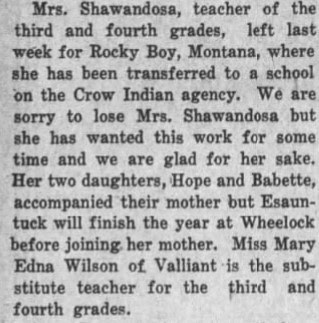
The McCurtain Gazette 19 Nov 1932 shows Jonas' ex-wife and daughters were living in Idabell, Oklahoma, and moving to Rocky Boy, Montana.
On 2 Sep 1933 ex-wife Adaleen married Albert Sutherland in Harve, Montana

In 1933 the Michigan Indian Defense Association was formed by Jonas Shawandase, Ben Peshawbe, Joe Chingan, Edward Hall, Paul Ahgosa, Alex Wasaquam and George Sands.
Detroit Free Press, 31 Dec 1933
Indians Invoke Tribal Law to Curb White Debauchery
Left to right: Standing--John Gingway, assistant chief; Edward Hall, counsellor; Paul Agosa, counsellor; Aelxandrine Wahsequom, counsellor; George Sans, counsellor. Sitting--Ben Peshawba, chief; Jonah Shawandase, second chief. The Council will judge white maruders.


Jonas' father, Louis, died 25 Dec 1937 in Enterprise, Missaukee, Michigan


1940 Federal Census - Leelanau, Leelanau, Michigan
Shandase, Jonas, head, 57, single, lived in same house in 1935, no occupation
Hall Jesse, sister, 47, widow, lived in same house in 1935, no occupation

On 27 Apr 1942 Jonas registered for the World War II draft. He was described as 5 ft 7 inches, 155 pounds, Indian, black eyes, gray hair, dark brown complexion.


1950 Federal Census - Leelanau, Leelanau, Michigan
Shawandase, Jonas, head, 70, never married, born in Michigan
Hall, Jessie, sister, 58, widow, born in Michigan
Hall, Edith, cousin, 22, separated, born in Michigan
Hall, Louis W., cousin, 6, born in Michigan
Hall, Julian, cousin, 4, born in Michigan

1950 Federal Census - Wharton Creek, Madison, Arkansas
Sutherland, Adalen, head, 57, divorced, born in Ohio
Shawandasa, Babette T., daughter, born in Ohio
[Shawandosa], Hope W., daughter, born in Ohio
Sutherland, Robert L., son, born in California

Holland Evening Sentinel 18 Jun 1952
Northport Indian Recalls History Of Soldier Family
Jonas Shawandosa, a 74-year-old full-blooded Ottawa Indian from Northport comes from a family of soldiers.
Members of his family have served in every war from the War of 1812 down trhough the two World Wars and now a cousin is serving in Korea.
Shawandosa, the only Indian attending the 49th annual encampment of the Untied Spanish War Veterans which ends today volunteered during the Spanish-American war in 1898. He served with the Second U.S. Cavalry, Troop E, for three years, acting as a dispatch rider carrying messages between fron line troops and rear units.
Shawandosa said it was not considered out of the ordinary to ride all day and night to get an urgent message to the front.
"The war then wasn't too much different than now," he said, "but then we had nothing overhead or under the water." He was referring to modern use of airplanes and submarines.
Speaking of the food served during the Spanish-American War, he said, "The grub was no good. We got a ration of about 12 cents a day, which gave us one or two pieces of hard cakes and a piece of embalmed beef."
Recalling his family-s history, Shawandosa said his great-grandfather sered in the war of 1812, his grandfather found with the Union army in 1860 and his father rode with the U.S. Cavalry in the 1870's.
In addition a brother was with the Army in World War I and a nephew joined up in World War II.
Shawandosa is especially proud of his three daughters, all college graduates. He said, "Going to college was something I wanted and couldn't get." One daughter graduated from the University of North Dakota and the other two from the University of South Dakota."


Chicago Tribune 28 Jun 1953

Traverse City Record-Eagle, 8 Jul 1955
By AL BARNES
"Today I read a living page from History knowing that one day in the not distant future that page will be torn out and its text lost forever. As I read, I walked with Jonas Shawandosa over the site of the old pagan Indian village of Louisville and stoood beside the Indian burial ground which Jonas said was probably 300 year old.
Jonas Shawandosa is 76 years of age.. he will be on July 7, and he is sprightly of mind and body. He can trace his family back at least 200 years and the history of his family is the history of the Leelanau county area. He was born near Northport as were his father and mother before him and his life like theirs has been an Indian chronology of the years.
Louisville settlement once stood on a high bluff overlooking Lake Michigan at a point where Petersen park is now located about two miles north of the village of Northport. Ind the beginning it was composed of scores of bark shacks which housed a band of unbelievers' of the Ottawa tribe. While an overwhelming makourity of the natives believed in the Great Spirit the Ottawas at Louisville did not.
There is no record, presumably of the beginning or the end of the settlement. Earlier it has an Indian name which has been lost. About a century ago it took the name of Louisville after a resident Louis Kookosh which literally translated, means Louis the Pig.
Not one person in a round thousand knows where the village stood and even fewer of the residents know where the burial ground unhallowed and unmarked, is located.
The cemetery if such it can be called can be reached by parking at the entrance of Petersen park and walking to the right about a quarter of a mile, skirting an area of second growth and then a few rods to the right.
There are no markers over the graves and nothing to indicated that scores of bodies lie beneath the sod. Sunken spots indicate individual graves. A tangle of rusted barbed wire lies in the grass and once many years ago kept live stock from grazing the spot. Some of the burial ground has been plowed up and its area reduced until, toay there is only a spot about 50 by 45 feet remaining.
Here are buried the remains of Indians who lived their untrammeled lives beofre the American Revolution. They lived from the land and returned to the land. Even Jonas Shawandosa has no idea as to how many graves were originally in the area or whose they might have been. It was abandoned before his time and the village of Louisville was gone. Part of it was located on a farm belonging to Archie Scott on which the cemetery is situated.
It is certain that the cemetery antendated the one at Onominee about five miles from the village of Northport. It is in the latter enclosure that Jonas parents, Louis and Sarah Shawandosa are buried. Here too are the remains of scouts of the Indian wars veterans of the Sioux uprigins two Civil War veterand and scores of others. Not many of the graves are marked and there are only memories fast being taken away to keep the page of the book readable.
Jonas, who enlisted in the army when war broke out with Spain was in the Second Cavalry unit in the army of occupation in Cuba. He has lead an active life and is a respected resident of the Northport community. He lives on the old family farm between Northport and Leland. At 76 he still drives his automobile and does any work he deems necessary.
The name Shawandosa means southward and can refer to any thing south such as a trip, a home, a place.
The Ottawa language which is spoken fluently by Jonas, is dying out.
"The young folks don't speak it," he explained "and the older ones are leaving. I almost forgot the language for many years and then I began using it."
It is a pretty language soft like French, musical as Spanish and with a force not unlike Yankee English. It is spoken today by a few, but read by many less.
If a resident of this region would like to spend an hour of enchantment or if a guest would like to step back into history, they should visit Jonas and walk with him over the soil where once stood the village of Louisville. They should hear him speak of his ancestors among them cheiftains, and look with him as he stand on the bluff and points toward the Manitous.
Some manner should be devised whereby the old burial ground on the Scott farm could be once again fenced and protected. There should be an unpretentious plaque located on a permanent base that all who follow will known, Here lived and died a simple and kindly people."


12 Sep 1955

The Courier - Journal, Louisville, KY 2 Sep 1958
Spainsh-War Vet Advises Ike To 'Go After' Red China
Indian Chief Is Attending Convention Here
A 79-year-old Indian hief and Spanish-American War veteran gave President Eisenhower some advice yesterday on the Red China-Quemoy Islands crisis.
"If Uncle Sam goes after them now, we can take them. But if we wait too long, they will invent something new and can make it hot for us."
Jonas Shawandosa, who comes from a family of soldiers, doubts that the world will ever find peace.
"That's a hard question to answer," said Shawandosa, who is attending the United Spanish War Veterans convention here.
Belived Oldest Chief
Shawandosa, believed to be the nation's oldest tribal chief, is a fourth-generation soldier.
His great-grandfather served with the United States in the War of 1812; his grandfather fought with the North in the Civil War, and his father fought with federal troops in the Indian War of 1874.
"My grandfathers and father were soldiers, and I felt it was my duty to be a soldier, too," he said.
Enlisted in 1900
"Indian Joe," as his friends call him, sadly admits the family tradition has ended. He has three daughters, but no sons.
Shawandosa enlisted in the Army in 1900 and served with the occupation forces in Cuba after the war. He served in a cavalry unit that had several skirmishes with Cuban outlaws.
The Ottawa Indian chief, who fought with carbine and pistol, said soldiers today have a better chance of survival because of the modern weapons.
"But as for bravery, I think soldiers today are just as brave," he said. "They all have American blood."
After his discharge in 1903, Shawandosa spent a summer as a trick horseback rider in a Wild West show. He entered a Nebraska Indian school in 1906 and became a stationary engineer.
Until last March, when he had pneumonia, Shawandosa had never been sick a day in his life. He agreed with a recent medical report that Spanish-American War veterns, whos average age is 84, have a constutuion of a 50-year-old man.
"We do a lot of outdoor exercises and don't do as much heavy drinking as the young generation," the Indian Veteran said.
Shawandosa, who retired as a painter and decoration five years ago, spends most of his spare time horseback riding on his 7-acre farm near North Port, Mich., where he lives with a sister.
He was born in North Port and has lived in Michigan most of his life. He is an honorary sheriff of Leelanau County.

Grand Rapids Press 24 May 1964

Kalamazoo Gazette 16 Jun 1964
By JIM STOMMEN
Gazette Staff Writer
Among the 50-plus United Spanish War Veterans attending the 61st annual state encampment is a part-Chippewa, part-Ottawa Indian whi is a much a part of the state encampments as is each year's department commander
The three-day encampment, which opened Sunday at the Burdick HOtel, cloes with the election of officers today.
Jonas Shawandosa, now 85, enlisted in Philadelphia, Pa., on Sept. 13, 1900, and was shipped with the Second Cavalry to Cuba in relief of troops there, He served until 1903, when he was discharged, just a few months before the unit was shipped to the Philippines.
A member of Hannah Camp No. 23, Traverse City, "Chief" Shawandosa (as the other veterans fondly call him) lives in Northport, some 30 miled north of Traverse City on Grand Traverse Bay.
He says he's a Chippewa on his father's side and an Ottawa on his mother's side. Shawandosa's great-grandfather served in charge of a group of Indian scouts in the War of 1812. His grandfather served in the Civil War.
According to Andrew Bradley, state USWV adjutant-quarter-marger, Shawandosa rarely misses an encampment. He pointed out that the first thing most of those attending the annual encampments do is to inquire as to whether the "Chief" has arrived yet.

Petoskey News-Review 30 Dec 1964

THE STARTING POINT of the Indian claims against the federal goverment was photographed 16 years ago this month when these officers of the Northern Michigan Ottawa Association met above the former Northern Michigan Review office to start legal steps. Seated are Mr. and Mrs. Robert Dominic who have carried on despite many obstacles. In the backgroun are John Ance, Petoskey, Jonas Shawandosa, Northport and the late Levi McClellan of Bay Shore who was the man who urged the Indians carry their fight to Washington. Shawandosa is now past 90, Ance is also deceaded. (NEWS file photo by Jim Doherty.)
Leelanau Enterprise - 27 Oct 1966

From Dbaajimowinan - story excerpts from the Elders of the Grand Traverse Band of Ottawa & Chippewa Indians.



Pictures - location and date unknown


Jonas died 18 Feb 1970.
Traverse City Record-Eagle 19 Feb 1970. [Errors include his age and military service]

The Traverse City Record-Eagle printed an obituary (full of errors) in the 20 Feb 1970 edition.
Rites Set for Spanish War Vet Saturday
Funeral services for Jonah Shawadasa, the last Spanish-American War veteran in Leelauan County, will be held Saturday at the Ray Martinson funeral home in Suttons Bay.
Mr. Shawadasa, who died at the age of 99, was born July 7, 1871 in Northport. At the time of his death he was living at the home of a niece in Allegan.
During the Spanish-American conflict, Mr. Shawadasa was a member of Theodore Roosevelt's Rough Riders. He fought throughout the Cuban campaign including the famed charge up San Juan Hill.
Survivors include three daughters, Mrs. Eusantia Kelly of Los Angeles; the Misses Bata and Elizabeth Shawadasa of Jouston, Ark; a sister, Mrs. Jessie Hall of Northport, and four grandchildren.
The Reverend Joseph Sprague of Grand Rapids will officiate at the services in the Ray Martinson funeral home. Military services are under the auspices of the Leelanau County American Legion POst No. 199.
Burial will be in Oakwood cemetery in the Spanish-American War section.

Jonas was buried in the Oakwood Cemetery in Traverse City, Grand Traverse, Michigan. [Birth date is wrong, spelling of his name is from his military records.]


From the Madison County Record, 8 Mar 1990.


Daughter Esauntuck died 4 Jun 1993
Daughter Babette died 15 Jan 1999 in Fayetteville, Washington, Arkansas
21 Jan 1999

Babette and Hope are buried in Huntsville Cemetery, Huntsville, Madison, Arkansas

Copyright (c) 2023 Vicki Wilson
Updated November 2025
Link to Michigan Native American Ancestors Facebook group.





